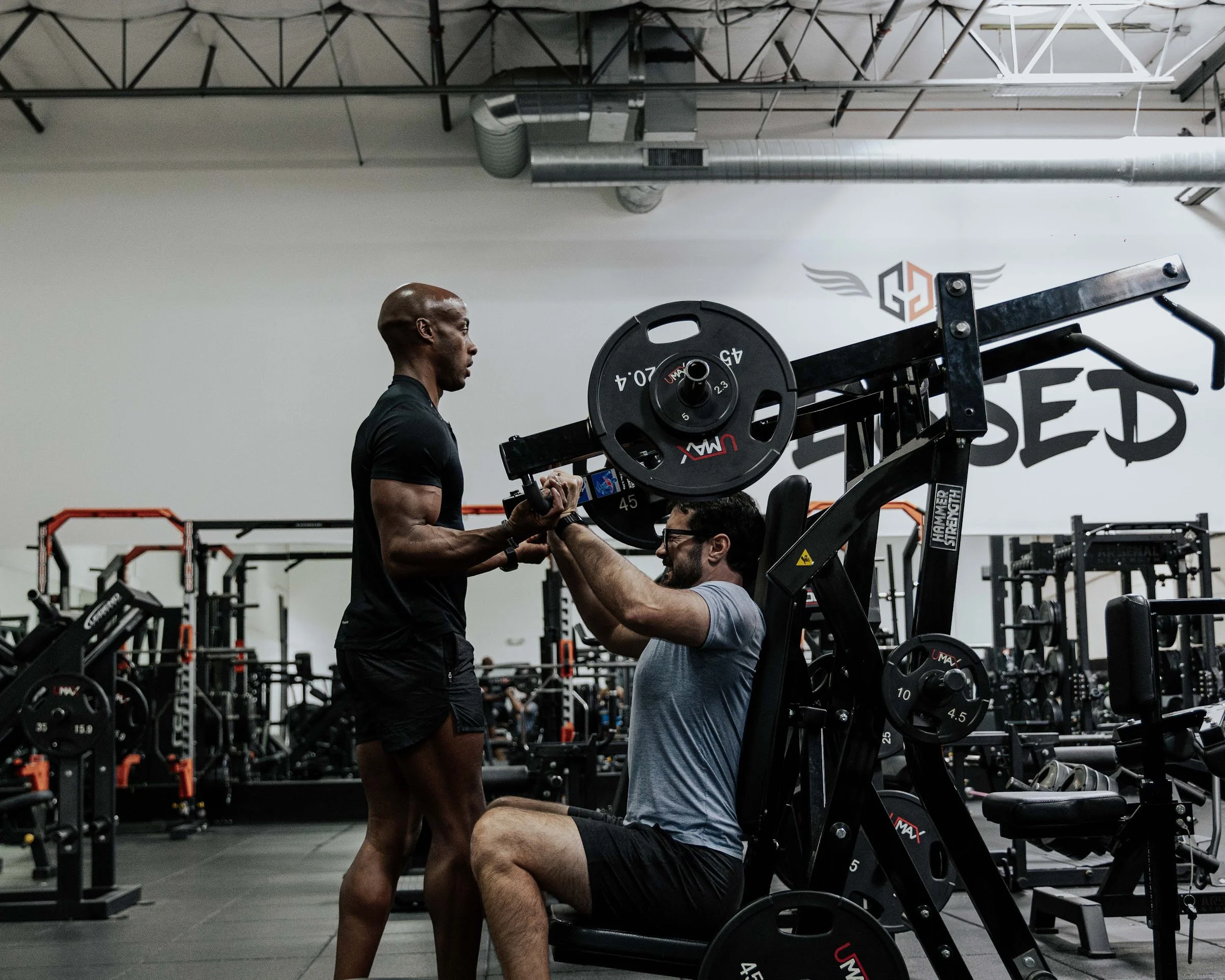
When your calendar is full, a training plan has to be simple enough to start on Monday and tough enough to survive a bad week. This is the three-day routine I use as the starting point for most busy professionals I coach in Scottsdale. It builds muscle, it fits in 45 minutes, and it works with a basic gym or a few kettlebells.
The schedule
Train Monday, Wednesday and Friday, or any three days with a rest day between them. Walk on the other days, 7,000 to 10,000 steps. If three days isn't realistic yet, do Day A and Day B and add the third day later. Two sessions you actually do beat three you skip.
Day A
Goblet squat: 3 sets of 8 to 10
One-arm dumbbell row: 3 sets of 10 each side
Romanian deadlift: 3 sets of 8 to 10
Push-up or dumbbell bench press: 3 sets of 8 to 12
Finisher: 10 kettlebell swings every minute for 8 minutes
Day B
Trap bar or kettlebell deadlift: 3 sets of 6 to 8
Half-kneeling one-arm press: 3 sets of 8 to 10 each side
Split squat: 3 sets of 8 each leg
Lat pulldown or assisted pull-up: 3 sets of 8 to 12
Finisher: farmer's carry, 4 trips of 40 yards
Day C
Front squat or leg press: 3 sets of 8 to 10
Chest-supported row: 3 sets of 10 to 12
Hip thrust or glute bridge: 3 sets of 10 to 12
Incline dumbbell press: 3 sets of 8 to 12
Finisher: 6 minutes on the bike, 20 seconds hard, 40 seconds easy
Pair the first two exercises and the last two as supersets: one set of the first, one set of the second, rest a minute, repeat. That keeps the whole session around 45 minutes.
How to progress
Pick a weight that lets you finish the bottom of the rep range with good form and a rep or two left. When you can hit the top of the range on every set, add a little weight next time. Write it all down. A training log is the cheapest coach you'll ever have.
Recovery between sessions
Protein at every meal. Roughly 0.7 to 1 gram per pound of goal body weight per day.
Seven hours of sleep as often as you can manage.
A walk on rest days.
An easier week every 6 to 8 weeks: same exercises, about half the sets.
Travel weeks
Keep the structure, shrink the session. One superset and the finisher takes 20 minutes. With a single kettlebell you can do goblet squats, single-arm rows, swings, presses and split squats in a hotel room.
What to expect
Most people feel stronger within three or four weeks and see visible change in 8 to 12. Stick with it for 16 weeks and get a DEXA scan before and after. That's how you know the change is muscle and not just a number on a scale.
How to warm up
Five minutes before every session:
10 kettlebell halos in each direction.
10 goblet squats with a light weight, pausing at the bottom.
10 hip hinges with a light kettlebell or dumbbell.
Two lighter sets of your first exercise before the working sets.
That's enough to raise your temperature and get your joints ready without eating into your training time.
How heavy should you go?
The right weight is one you can lift for the full rep range with good form and one or two reps left at the end of each set. If you hit the top of the range easily, it's too light. If your form changes in the last reps, it's too heavy. Most people start too heavy, stall, and get frustrated. Start a little lighter than you think and build up.
Swaps if something hurts
Goblet squat bothers your knees? Try a box squat to a bench.
Romanian deadlift bothers your back? Try a kettlebell deadlift from a raised surface.
Push-ups hurt your wrists? Use dumbbells or push-up handles.
Pull-ups too hard? Use a band or the lat pulldown.
The goal is the movement pattern, not the specific exercise.
Common mistakes
Changing the program every two weeks. Run this one for at least 12 weeks before you judge it.
Skipping the log. Without numbers you don't know if you're improving.
Adding a fourth and fifth day too soon. More isn't better if you can't recover from it.
Dropping the finisher every time you're short on time. Cut a superset instead.
Frequently asked questions
Can I do this at home? Yes, with a few kettlebells or adjustable dumbbells and a bench. Swap the trap bar deadlift for a kettlebell deadlift and the lat pulldown for a band-assisted pull-up or a single-arm row.
How long should I rest between sets? About 60 to 90 seconds between supersets is enough on this plan.
Should I train to failure? No. Finish most sets with one or two reps left. You'll recover faster and keep progressing longer.
Why full-body sessions work for busy schedules
Each day in this plan trains your whole body. That matters when your calendar is unpredictable. If you miss Wednesday, your legs, back and chest still got trained on Monday and will get trained again on Friday. With a body-part split, one missed day can mean a muscle group goes untrained for two weeks. Full-body sessions make the plan forgiving, and a forgiving plan is one you'll keep.
A plan built around you
For coaching built around your goals and schedule, start a conversation with Akram. Together, you can discuss your starting point, assess fit, and explore your next step. Coaching investment is discussed privately.
Related reading
References
About the author
Akram Hameed is the founder of Body By Akram and an executive fitness coach in Scottsdale, Arizona. Since 2019, he has coached CEOs, entrepreneurs, and professionals who want their health and physical capabilities to reflect the standards they bring to the rest of their lives. A Certified Personal Trainer, Certified Nutritionist, and Strength and Conditioning Coach, he combines training with nutrition, habit formation, behavior change, and personal accountability. His approach includes Proteus strength and power testing and DEXA body composition scans. For clients exploring hormone optimization, he coordinates physician-reviewed blood work. Follow him on Instagram.
This article is general education, not medical advice. Check with your doctor before starting a new training, nutrition or supplement plan.