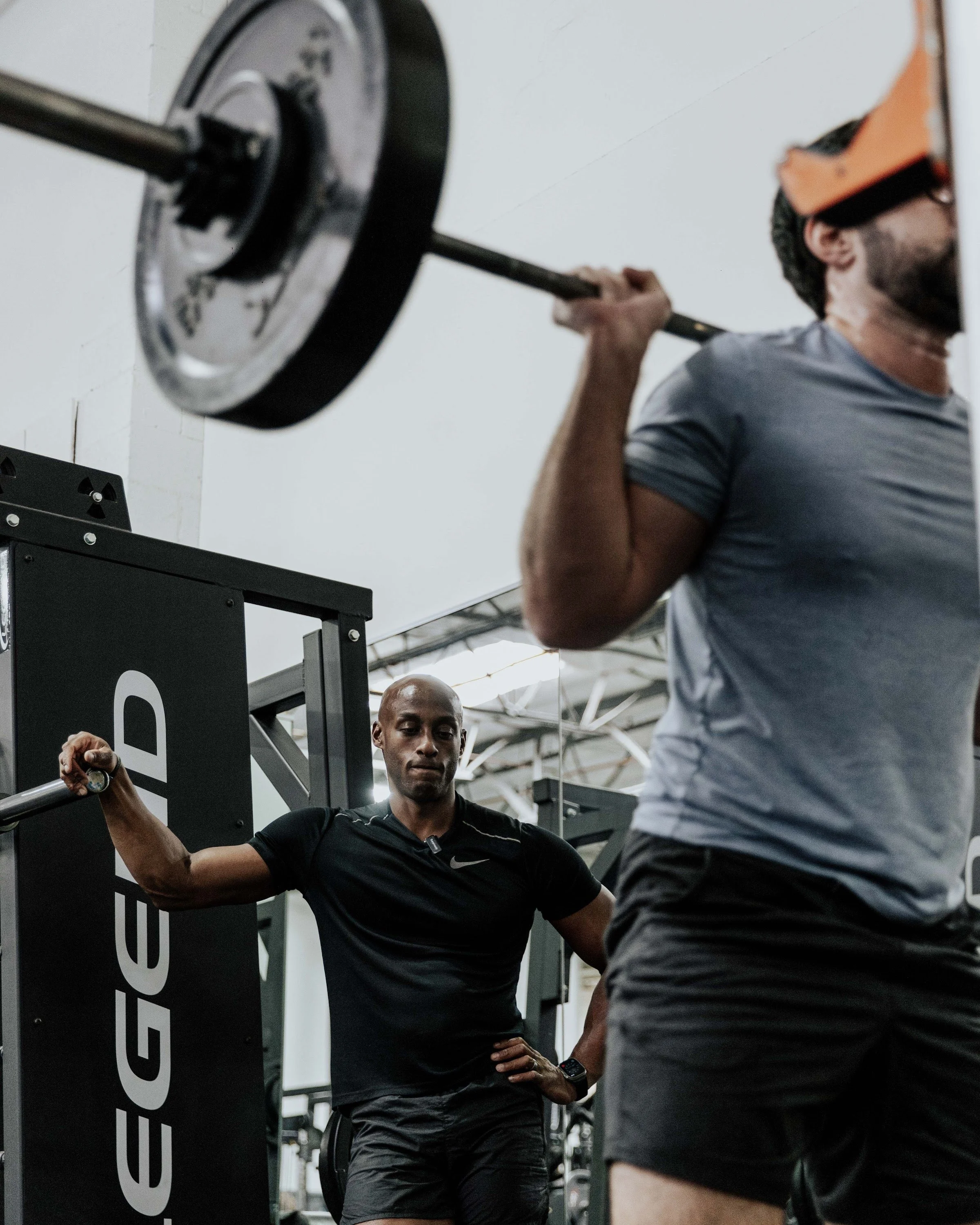
The biggest threat to your progress after 40 isn't a slow metabolism or low testosterone. It's the tweaked back or cranky shoulder that takes you out for six weeks, then another one three months later. Most of the men I coach can remember a year where they "started over" two or three times.
You don't avoid that by training scared. You avoid it by training smart. Here's how I keep clients progressing for years without getting hurt.
Earn the load
Every exercise has a version you can do with perfect form today. Start there, even if it feels too easy. Add weight in small jumps, 5 pounds at a time on lower-body lifts and less on upper body. If your form changes when you add weight, the weight isn't yours yet.
Leave reps in the tank
Most of your sets should end one to three reps before you'd fail. That's still hard work, and it's plenty to build strength and muscle. Grinding out ugly reps to failure on squats and deadlifts is the fastest way I know to get hurt at this age.
Warm up the joints, not just the muscles
Five minutes is enough. I use kettlebell halos for the shoulders, goblet squats for the hips and knees, and light hip hinges for the back. Then two or three lighter sets of your first exercise before the work sets.
Pick exercises that fit your body
You don't have to back squat or barbell bench press. If a movement hurts every time, swap it for one that trains the same pattern without the pain:
Back squat hurts? Try a goblet squat or a trap bar deadlift.
Barbell bench bothers your shoulder? Try dumbbells or push-ups with a neutral grip.
Conventional deadlift hurts your back? Try a trap bar, a kettlebell deadlift, or a Romanian deadlift with lighter weight.
Overhead press is a problem? Try a half-kneeling landmine press.
Recovery counts as training
Sleep, protein and walking aren't extras. They're what lets you come back stronger instead of more beat up. If you're sleeping five hours, lower the volume until your sleep improves.
When something hurts
A bit of muscle soreness is normal. Sharp pain, pain that changes how you move, or pain that gets worse each session isn't. Here's the rule I give clients:
Sharp pain during a lift: stop that exercise for the day.
Dull ache that settles within a day: reduce the weight or range of motion and keep training around it.
Pain lasting more than a week, swelling, numbness or tingling: see a doctor or physical therapist before you push through.
Training around an injury is almost always better than stopping completely. A sore shoulder doesn't stop you training legs.
The long game
The strongest 55-year-olds I know aren't the ones who trained the hardest at 40. They're the ones who never stopped. Progress that keeps going for ten years beats a great three months followed by an injury.
How I program around old injuries
Most clients come to me with a history. A bad back from college, a knee surgery, a shoulder that's been cranky for years. I don't ignore it, and I don't let it stop us. We find the version of each movement that works for their body today and build from there.
A client with a sore lower back might start with kettlebell deadlifts from a raised surface instead of a barbell from the floor. A client with a shoulder issue might press at an angle instead of straight overhead. Over months, as strength improves, we often work back toward the harder versions. Sometimes we never need to. The goal is muscle and strength, not a specific exercise.
The weekly structure that keeps you healthy
Three strength sessions a week, with a day between them.
Walking on the off days to keep blood moving and joints happy.
An easier week every 6 to 8 weeks, about half the usual sets.
One or two mobility drills before each session for the areas that tend to get stiff.
That structure gives your joints and tendons time to catch up with your muscles. Muscle adapts faster than connective tissue, and that gap is where a lot of injuries happen.
Signs you need to back off
You're sore in the same joint after every session.
Your warm-up sets feel heavy.
You're sleeping badly and dreading training.
Your lifts have gone backward for two weeks or more.
Any one of those is a reason to take an easier week, not to push harder.
Frequently asked questions
Should I stop lifting if I have back pain? Not always. Many people do better with modified training than complete rest. If the pain is severe, spreading, or comes with numbness, see a doctor first.
Do I need to stretch before lifting? A short warm-up with movement works better than long static stretches. Save longer stretching for after the session.
How fast should I add weight? In small jumps. If your form changes when you add weight, go back to the last weight and own it for another week.
Are machines safer than free weights? Not automatically. Machines are useful when you're working around an injury, but well-coached free weights are safe for most people.
A plan built around you
For coaching built around your goals and schedule, start a conversation with Akram. Together, you can discuss your starting point, assess fit, and explore your next step. Coaching investment is discussed privately.
Related reading
References
About the author
Akram Hameed is the founder of Body By Akram and an executive fitness coach in Scottsdale, Arizona. Since 2019, he has coached CEOs, entrepreneurs, and professionals who want their health and physical capabilities to reflect the standards they bring to the rest of their lives. A Certified Personal Trainer, Certified Nutritionist, and Strength and Conditioning Coach, he combines training with nutrition, habit formation, behavior change, and personal accountability. His approach includes Proteus strength and power testing and DEXA body composition scans. For clients exploring hormone optimization, he coordinates physician-reviewed blood work. Follow him on Instagram.
This article is general education, not medical advice. Check with your doctor before starting a new training, nutrition or supplement plan.