What a DEXA Scan Shows, and Why Every Executive Should Get One
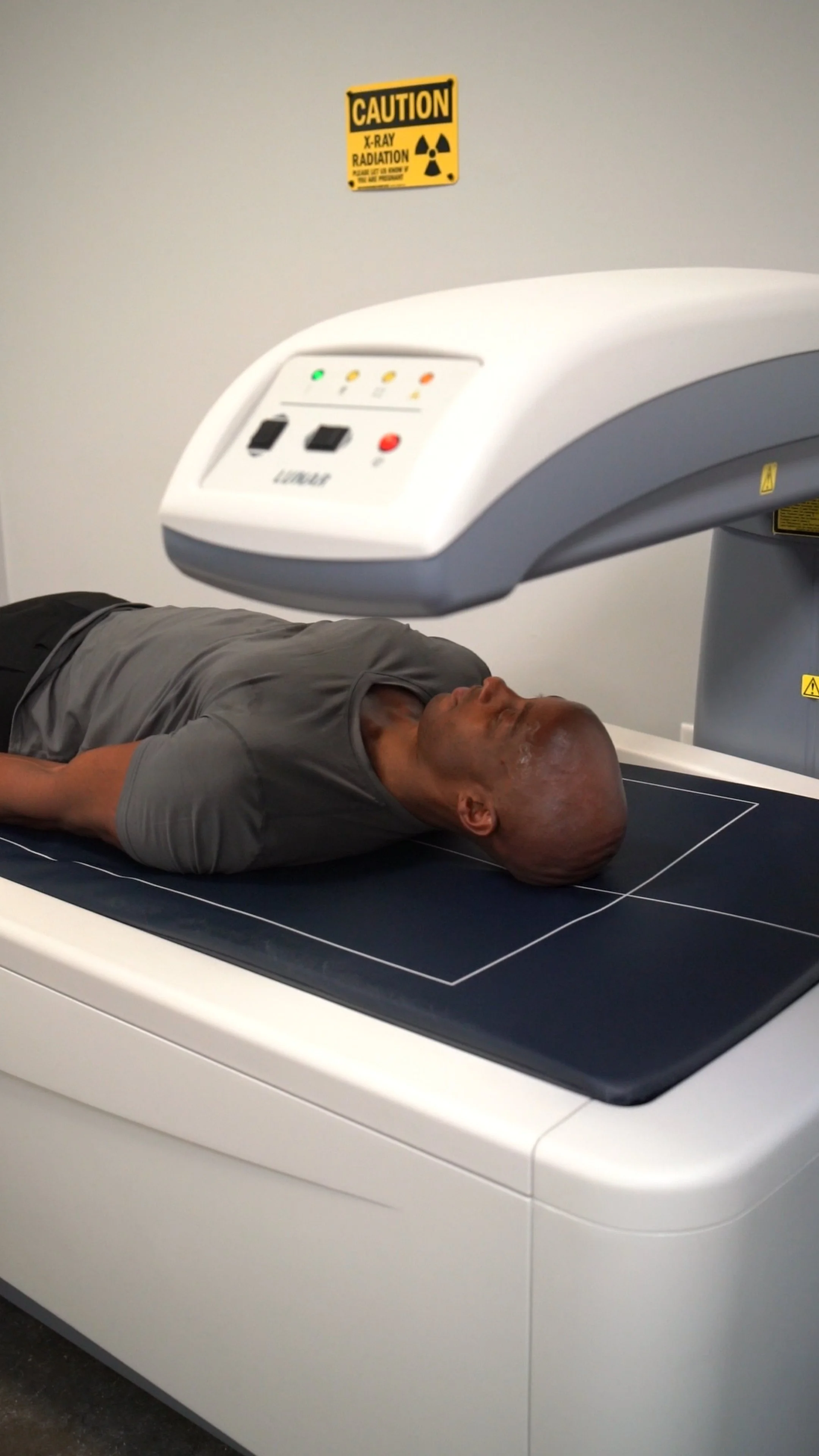
A DEXA scan can add useful detail to a body-composition conversation, but it does not reveal an exact or complete picture of health. It estimates fat mass, lean soft tissue and bone mineral content using a low-dose X-ray method. The result is most useful when you understand what was measured, compare like with like, and interpret the scan alongside strength, daily function, health history and goals.
For a busy executive, that context can be more helpful than scale weight alone. The scale reports total body weight; it cannot distinguish fat mass from lean tissue. A DEXA report can estimate those compartments and show regional patterns. But it is still an estimate from a particular device and protocol—not a diagnosis, a promise of future results, or a reason to make a drastic change after one reading.
What does DEXA mean?
DEXA, also written DXA, stands for dual-energy X-ray absorptiometry. The scanner uses two X-ray energy levels to estimate how tissues attenuate the beams. In a whole-body composition scan, the software separates the body into broad compartments such as fat mass, lean soft tissue and bone mineral content, and can report regional estimates. A bone-density DXA exam is a different clinical use of the technology, commonly focused on specific skeletal sites.
The scan itself is noninvasive: you lie still on a table while the scanner passes over you. The facility provides instructions about positioning, clothing and preparation. Scan time, dose and reporting details vary by machine, exam type and provider, so ask the facility what kind of scan is being performed and what its report includes.
What the report can tell you—and what it cannot
Fat mass and body-fat percentage. These are estimates of total fat tissue and its share of body weight. They can add context when weight changes, but should not be treated as exact values or used alone to judge health.
Lean soft tissue. This includes water and non-fat, non-bone tissue; it is not a direct measurement of skeletal muscle strength or muscle quality. A higher lean-mass estimate does not automatically mean better performance, and a lower one does not diagnose a condition.
Regional estimates. The report may divide estimates among areas such as arms, legs and trunk. Positioning, body size, software and analysis conventions can affect the results. Small left-right differences are not automatically a problem and should not be used to diagnose an imbalance.
Visceral adipose tissue estimates. Some systems estimate fat in the abdominal region using the scan and software. Treat that as an estimate, not a direct visualization or diagnosis of disease risk. Ask the reporting professional how the number is generated and what conclusions are appropriate.
Bone mineral information. A whole-body composition report is not a substitute for a clinician-ordered diagnostic bone-density assessment. If bone health is a concern, discuss the right test and interpretation with a qualified healthcare professional.
Why body weight alone can miss the trend
Body weight is still useful when measured consistently, but it combines many components and naturally fluctuates with food, fluid, sodium, bowel contents and travel. If weight is stable while a person is training, eating adequately and improving strength, that number alone cannot tell whether body composition has changed. Likewise, a short-term drop on the scale does not establish that the change came only from body fat.
A composition scan can add another data point to a longer review. It should sit alongside training records, waist or clothing changes when appropriate, energy, recovery and relevant clinical measures. No single measurement proves that a program is succeeding or failing. The useful question is whether several indicators, taken over an appropriate period, support the same conclusion.
A client example—and an important limitation
One client, John, is 69 and spent three months traveling during a seven-month coaching period. His recorded DEXA reports showed an increase of 14.3 pounds in lean mass, a decrease of 12.7 pounds in fat mass, and a change in reported body-fat percentage from 21.4% to 14.1%. These are his reported scan results, not a typical outcome or a guarantee. His experience also cannot establish that coaching alone caused every measured change.
Because the reported changes are substantial, interpretation depends on the scan dates, devices, preparation, analysis and the rest of his health and training context. Hydration and glycogen shifts can affect lean-tissue estimates, and measurements from different machines may not be directly interchangeable. The lesson is to review the underlying reports and conditions with the testing provider, then use the information as one part of the coaching conversation—not to assume every number equals a precise amount of newly built muscle.
See more client results.
How to make a follow-up scan more useful
If you and your healthcare or testing provider decide repeat measurement is appropriate, consistency helps. Use the same facility and device when possible, follow that provider’s preparation instructions, and record the date and any relevant circumstances such as recent strenuous training or unusual travel. Do not change hydration, food or exercise to try to manipulate a result. Ask the provider what amount of change is larger than the system’s expected measurement error before drawing a conclusion.
There is no universal scan interval that fits everyone. Repeating too soon may cost money without giving enough time for a meaningful trend, while repeated exposure should be discussed with the provider based on the exam type and your circumstances. Follow the testing center’s advice and consult a clinician if you have questions about radiation exposure, pregnancy, bone health or medical indications.
How I use measurements in coaching
In coaching, a measurement is useful only if it helps inform a reasonable next step. When a client chooses a DEXA scan and the results are relevant, I review the report as context for goals and progress, alongside training history, schedule, preferences and feedback. I do not use a scan to diagnose, prescribe medical treatment or replace a clinician’s care.
That distinction matters. A scan does not set a calorie target by itself. Resting metabolic rate is a separate estimate of energy use at rest, and it is not total daily energy expenditure. A nutrition plan still needs to be evaluated over time using real-world patterns, training quality, hunger, energy and the direction of weight or composition trends. Unexpected findings or health concerns belong with qualified healthcare professionals.
For founders and senior professionals, the practical benefit is often a clearer conversation: What are we trying to change? Which measures are relevant? What habits fit the coming month? What would count as a sensible adjustment? The answer may be training consistency, a more manageable schedule, nutrition basics or simply collecting better baseline information before changing anything.
Frequently asked questions
Is a DEXA scan safe? DEXA uses ionizing radiation. The dose is generally low, but the amount depends on the exam and equipment. Ask the imaging provider about the specific scan and discuss individual risks with a clinician, especially if pregnant or potentially pregnant.
How often should I get scanned? There is no one-size-fits-all interval. Consider the purpose, cost, expected measurement error, exposure and provider guidance. A clinician may recommend a different schedule for a medical bone-density assessment than a coaching client might consider for body composition.
How should I prepare? Follow the imaging provider’s instructions. For repeat comparisons, ask how to keep preparation and timing reasonably consistent. Do not assume that a protocol suitable for one scanner or exam is right for another.
Can DEXA prove I gained muscle? It can estimate changes in lean soft tissue, but lean tissue is not identical to skeletal muscle. Interpret changes with the same-device protocol and alongside training performance and other context.
Start with a conversation
Body by Akram offers private performance coaching for founders and executives in Scottsdale. The best place to start is the $99 Executive Performance Audit: a private 60-minute assessment and a personalized 7-day plan.
This article is educational and is not medical advice. DEXA measurements have limitations and use ionizing radiation. Talk with the imaging provider or a qualified healthcare professional about individual testing decisions and results.
References and further reading
Bazzocchi A, et al. Body composition with dual energy X-ray absorptiometry: from basics to new tools. Quantitative Imaging in Medicine and Surgery. 2020. PubMed.
Nana A, Slater GJ, Hopkins WG, Burke LM. Effects of daily activities on dual-energy X-ray absorptiometry measurements of body composition in active people. Medicine & Science in Sports & Exercise. 2012. PubMed.
Webster JD, et al. The effect of hydration status on the measurement of lean tissue mass by dual-energy X-ray absorptiometry. International Journal of Sport Nutrition and Exercise Metabolism. PubMed.
RadiologyInfo.org. Radiation Dose from X-Ray and CT Exams. Patient information.
Huberman Lab. Dr. Andy Galpin: How to Assess & Improve All Aspects of Your Fitness. Episode. Educational discussion; not individualized medical advice.
ABOUT THE AUTHOR
Akram Hameed is the founder of Body By Akram and an executive fitness coach based in Scottsdale, Arizona. Since 2019, he has coached CEOs, founders and senior professionals across Scottsdale, Paradise Valley and Phoenix who want to lose fat, build muscle and get their energy back without guesswork. He is a Certified Personal Trainer, Certified Nutritionist, and Strength and Conditioning Coach. To learn more about his coaching practice, visit www.bodybyakram.com or follow @bodybyakram on Instagram: instagram.com/bodybyakram/.
