How a 69-Year-Old Reached 14.1% Body Fat While Traveling for Three Months
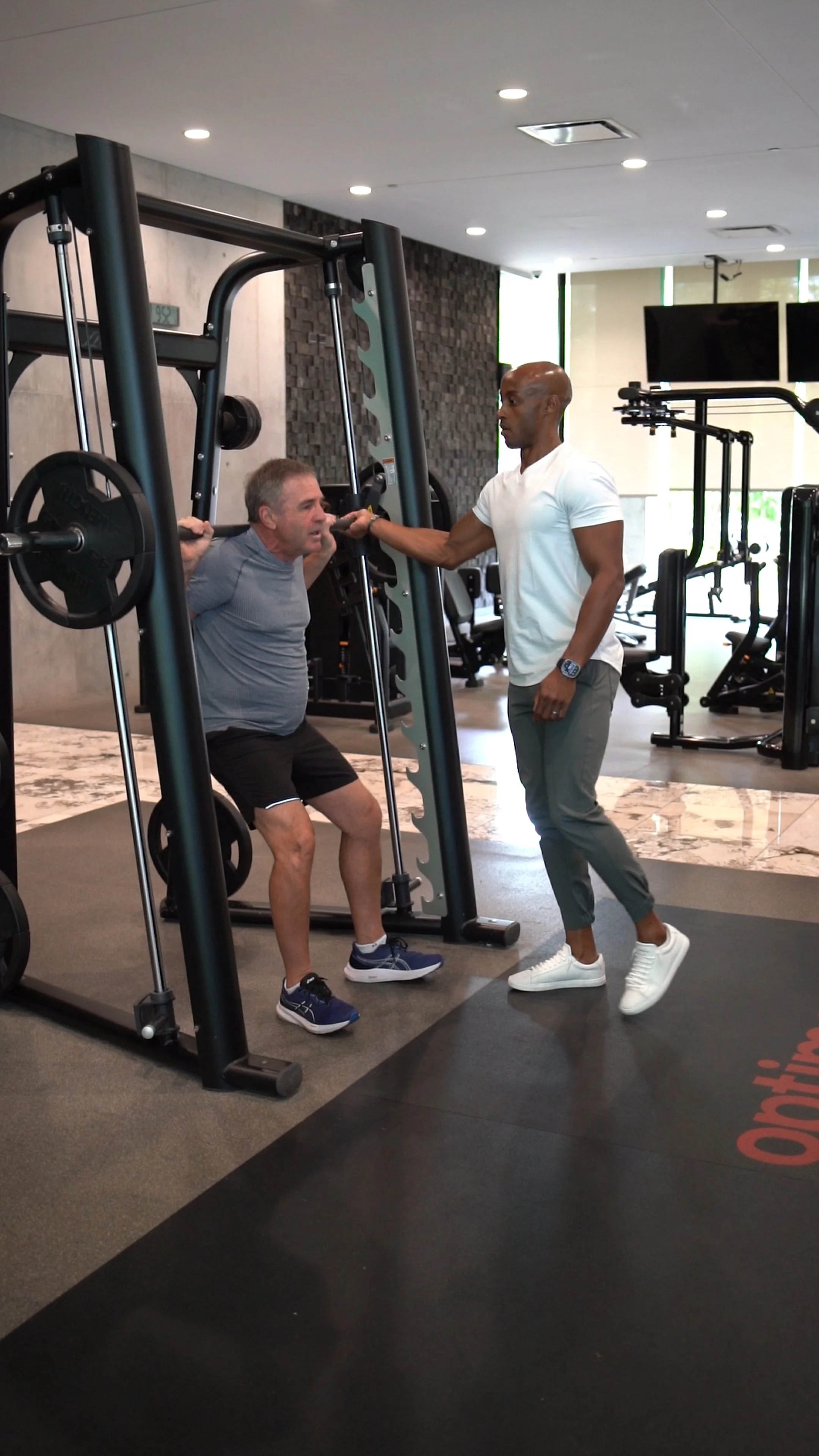
This client was 69 and busy, and three months of his coaching period were spent on the road. Most people treat a trip like that as a reason to pause. He didn't.
Over 33 weeks of coaching, travel included, his DEXA scans showed:
+14.3 lb lean mass
−12.7 lb fat
Body fat from 21.4% to 14.1%
He didn't do anything extreme to get there. He did a few simple things everywhere he went.
The challenge: a plan that could travel
Travel breaks routines. Meals happen at odd times, the hotel gym is a treadmill and two dumbbells, sleep shifts with the time zone, and the cues that make training automatic at home disappear. A plan that only works on a perfect week at home is fragile. His plan had to work wherever he was.
The habits that went with him
Protein at every meal. Wherever he was, the first question was where the protein was coming from.
Mindful food choices. No strict diet. Just better options at restaurants and less mindless snacking.
Daily movement on non-training days. Walking, the elliptical or the StairMaster, whatever was available.
None of those required a particular gym, kitchen or schedule. That's what made them stick.
Plan the fallback before the trip
This is the part I push with every client who travels: decide the minimum week before you leave. A full session if there's a decent gym, a shorter version if there isn't, and a walk on the packed days. When the backup is decided in advance, a schedule change is never a reason to do nothing.
What age changes, and what it doesn't
Recovery takes longer at 69 than at 39. But muscle still responds to strength training, protein and consistency. His scans show it, and so does the research on resistance training in older adults.
What you can take from it
Don't wait for the "right time" to start. There isn't one.
Pick three or four habits you can do anywhere.
Decide your minimum week before a trip, not during it.
Measure with DEXA so you know the change is fat, not muscle.
His results are his own, and yours will depend on your starting point and consistency. But if a 69-year-old can build 14 pounds of lean mass while living out of a suitcase, a busy schedule isn't the reason you can't.
What a typical travel week looked like
On the road, his week wasn't complicated. This is roughly what it looked like when he was away:
Two or three strength sessions in whatever gym the hotel had. A squat or lunge, a hinge, a push and a pull.
A walk every morning, usually before the first meeting. Twenty to forty minutes.
Protein at breakfast before anything else. Eggs, Greek yogurt, or a shake if the hotel had nothing.
One check-in with me every week. What he ate, how he slept, what he lifted.
When the hotel gym was good, he trained like he did at home. When it was a treadmill and a rack of light dumbbells, we used higher reps, slower lowering and split squats. The session changed. The habit didn't.
Eating out without a meal plan
He ate most of his meals in restaurants for three months. I never gave him a meal plan, because a meal plan doesn't survive a business dinner. He used three rules instead:
Order the protein first, then build the rest of the plate around it.
Swap one side for vegetables or a salad.
Decide before you sit down whether it's a dessert night or a drink night. Not both.
That's it. Simple enough to remember after a long day, and flexible enough to work in any city, at any restaurant, with any client across the table.
Why the scale wasn't the scoreboard
If he'd judged his progress by the bathroom scale, he would have been disappointed. He lost 12.7 pounds of fat, but he also added 14.3 pounds of lean mass. On paper, his weight barely moved. That's exactly why I measure every client with a DEXA scan at DexaFit. It separates fat, muscle and bone, so you see what's actually changing instead of guessing.
Most people quit a plan that's working because the scale tells them it isn't. He never had to guess. Every scan showed the trend going the right way, and that kept him going through the weeks when the trip was long and the motivation was low.
Recovery was part of the plan
We planned for recovery instead of hoping for it. Long flights, time zone changes and late dinners all chip away at it. A few things made the difference:
Keeping his wake-up time close to home time on short trips.
Getting outside in the morning light on long ones.
Lighter sessions the day after a flight, heavier ones once he'd slept.
An easier week when the travel stacked up, instead of forcing it.
Pushing through exhaustion doesn't build muscle. Training you can recover from does.
Frequently asked questions
Do you need a gym to keep progressing while you travel? No. A gym helps, but one kettlebell, a pair of dumbbells or your own bodyweight is enough to train the main movement patterns for weeks at a time.
Is it too late to start building muscle? No. How much you build depends on your starting point, training history and consistency, but muscle still responds to strength training, protein and time. His scans are the proof.
How often should you get a DEXA scan? Every 12 to 16 weeks is usually enough to see a real trend. Testing more often mostly measures noise.
Work with me
I coach a small number of executives one-on-one in Scottsdale, with DEXA scans to measure every change. If you want a plan built around your schedule, book a $99 Executive Performance Audit. You'll get a full strength, conditioning and mobility assessment and a personalized 7-day plan.
Related reading
References
About the author
Akram Hameed is an executive fitness coach in Scottsdale, Arizona, and the founder of Body by Akram. He is a Certified Personal Trainer, Certified Nutritionist and Strength and Conditioning Coach with a background in competitive kettlebell sport. Every client result he publishes is verified by DEXA scan. Follow him on Instagram.
This article is general education, not medical advice. Check with your doctor before starting a new training, nutrition or supplement plan.
